
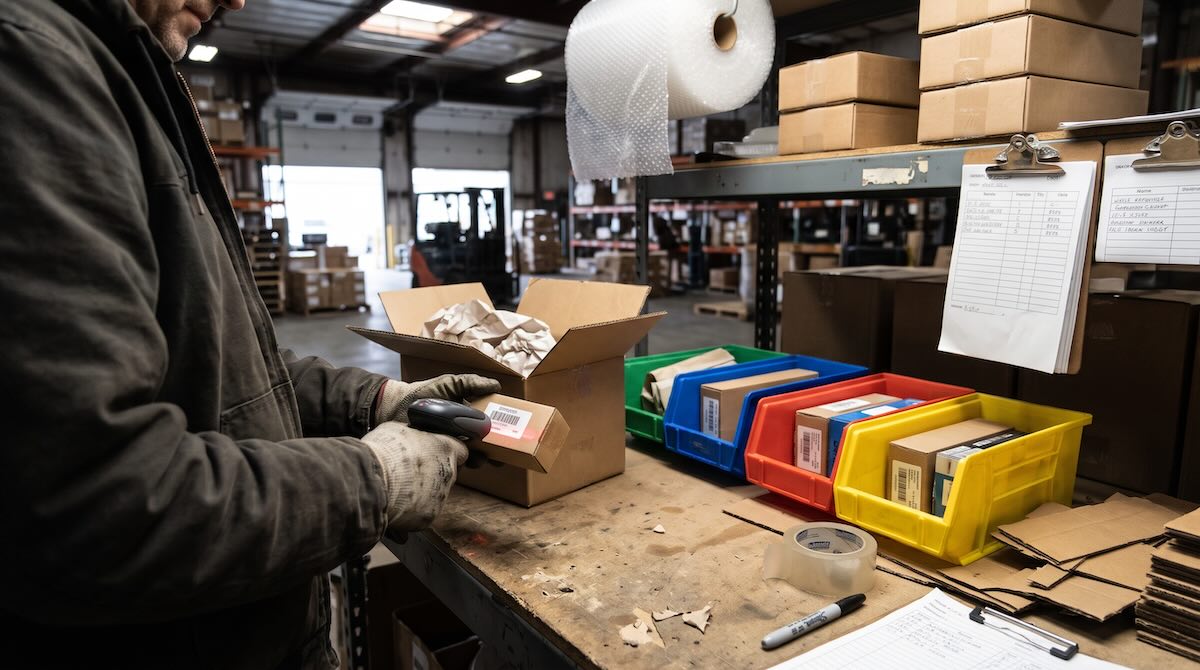
A busy warehouse can look productive while orders steadily fall behind. Employees walk the aisles, move cartons, answer questions, and check products throughout the day, yet completed shipments remain below expectations. Some of that activity advances customer orders; some compensates for missing location information, uncertain quantities, or mistakes made earlier in the process. Warehouse fulfillment bottlenecks develop when that extra work consumes the capacity the business expected to use for picking and shipping.
Adding people can increase output, but it can also put more employees into the same cycle of searching, waiting, and correcting. Reliable stock locations, better picking sequences, and barcode verification address different parts of that cycle. Their value comes from allowing more orders to move from release to shipment without intervention. Before treating fulfillment delays as a staffing problem, management needs to understand how much work each order requires that should never have been necessary.
Why a Busy Warehouse Still Falls Behind
Consider a distributor selling replacement components in several sizes with nearly identical packaging. A seasonal employee receives an order for six units, reaches the assigned bin, and finds only two. The system shows sufficient inventory, so the employee asks an experienced warehouse worker where the remaining stock might be. Together they locate a carton in overflow storage that was moved after the last delivery without an updated location record. The order can proceed, but two employees have spent time resolving a problem that began before picking.
The experienced employee’s knowledge keeps the operation moving while concealing its dependence on memory. During quieter periods, answering an occasional question may seem manageable. As volume increases or temporary workers join, those questions become a recurring interruption, reducing the output of the person asking and the person helping. Management sees a fully occupied team and may conclude that another hire is needed. In practice, some of the apparent labor shortage comes from requiring employees to reconstruct information that should already be available.
The consequences spread beyond the picking aisle. While that order waits, the packing bench may be ready for work; later, several delayed orders may arrive together just before the shipping cutoff. Customer service then needs updates, supervisors rearrange priorities, and employees rush to recover lost time. Evaluating warehouse capacity therefore requires attention to where orders stop and why, alongside how quickly employees perform individual tasks. An order that needs repeated assistance consumes more capacity than its picking time alone suggests.
Reliable Locations and Better Picking Reduce Different Delays
Reliable locations reduce uncertainty about where stock can be found. For the replacement-parts distributor, that means inventory remains traceable when it moves from receiving to a picking bin, into overflow storage, or back from packing. A location record that was accurate last week offers little help if employees have moved the goods without updating the system. The operating discipline behind the record matters as much as the location field itself. When employees can trust that information, routine fulfillment depends less on who happens to be working that day.
Picking organization addresses a separate problem: how much travel is required to collect the items. Depending on system capabilities, pick lists can present items in location order or support coordinated picking across multiple orders. That can reduce repeated trips through the same area, but it works best when locations are dependable and the sequence reflects the physical warehouse. A neatly ordered list still creates unnecessary walking if frequently purchased products sit far from packing or if employees repeatedly leave their route to replenish empty bins. Location accuracy helps the picker find the product; a sensible picking sequence helps the picker reach it efficiently.
In the distributor’s example, correcting the overflow location would remove the search, while preparing the picking bin before orders are released would eliminate an interruption during fulfillment. Reviewing where frequently ordered components are stored could then reduce the travel required for subsequent orders. These improvements reinforce one another without requiring every warehouse to adopt a complex routing process. For many smaller operations, the immediate opportunity is to remove predictable obstacles from ordinary orders. The right approach reflects order patterns, product characteristics, and available space rather than assuming that a more elaborate picking method will always produce better results.
Verify the Product Before an Error Becomes Rework
Once the seasonal employee finds the overflow carton, another risk remains: selecting the correct component size. Similar packaging makes visual identification difficult, particularly for someone unfamiliar with the product range. Where the system supports comparing scanned items with order requirements, barcode verification can flag a mismatch while the selection is being made. That gives the employee an opportunity to correct the pick before the item moves to staging or packing. Catching the mistake there limits how much additional work the business performs around an incorrect selection.
Without that check, the wrong component may reach the packing area, where another employee must investigate the discrepancy, locate the correct item, and arrange for the original product to be returned to stock. If the error escapes inspection, the business may face replacement shipping, a return, and a customer unable to complete a repair. The cost grows as the mistake moves farther from its source. Barcode verification is useful because it can bring the correction closer to the point of selection, while dependable locations reduce the likelihood of the wrong product being selected in the first place.
The control still needs to match the error the business intends to prevent. Confirming a SKU does not necessarily verify the quantity or contents of a sealed carton, and an unreadable label needs a practical resolution process. Employees also need to understand when a mismatch requires review rather than developing informal ways to bypass it under pressure. Those limitations should inform the workflow without obscuring the purpose of scanning: helping employees verify the product before an incorrect selection becomes someone else’s rework. The packing bench can then focus more consistently on preparing accurate shipments.
Bottom Line
Fulfillment improves when more orders move through the warehouse without searching, clarification, or correction. Management can assess that progress through orders completed without assistance, picking errors requiring rework, and shipments meeting their cutoff times. Those outcomes provide a more useful picture than walking speed or scan counts alone. The central opportunity is to remove unnecessary work from each order so existing warehouse capacity produces more dependable shipments.
Mariner Consulting Group helps manufacturers and distributors evaluate the location practices, picking workflows, and inventory system capabilities behind fulfillment delays. If your warehouse team stays busy while orders fall behind, Mariner can help identify where avoidable work is consuming capacity and what changes would improve the flow.

Leave a Reply