
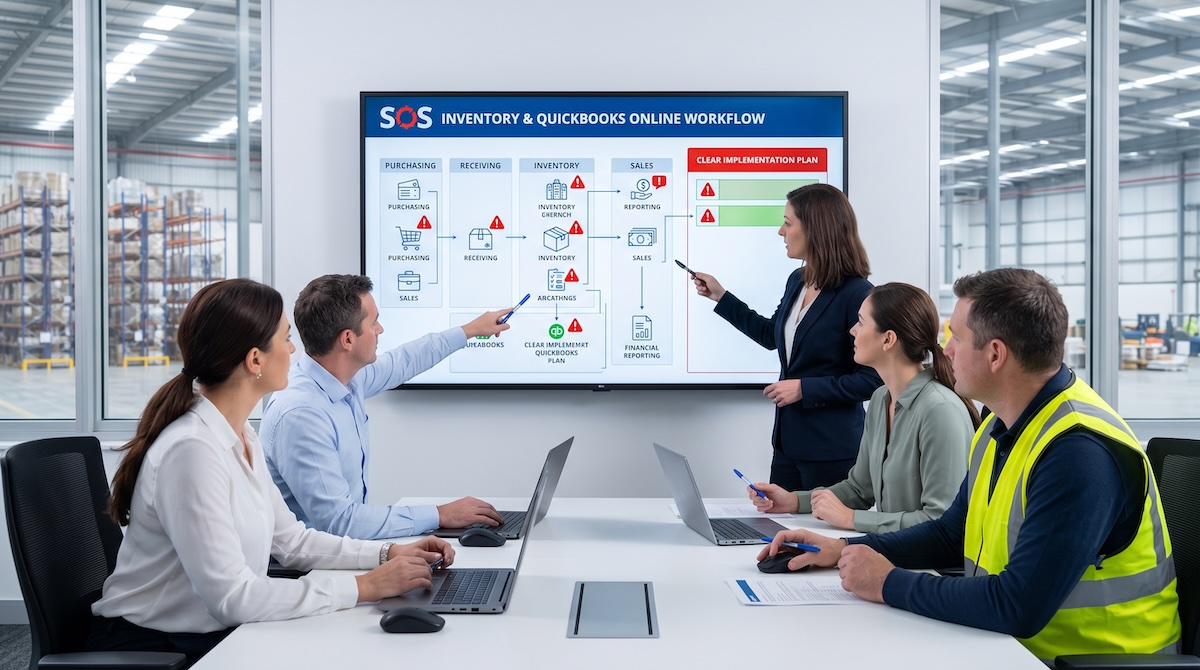
SOS Inventory can be a practical fit for manufacturers, distributors, and other inventory-driven businesses that need more operational capability than QuickBooks Online provides on its own. But selecting the software is only part of the decision. The larger question is whether the system, QuickBooks integration, workflows, reporting, and day-to-day processes are working together in a way that supports the business.
That is where an SOS Inventory consultant can become valuable. Companies rarely need outside help because they cannot find a particular setting. They need help when inventory problems begin affecting purchasing, fulfillment, financial reporting, or management’s confidence in the information coming from the system.
The most important distinction is this: software creates a foundation, but implementation quality, reliable data, sound processes, and consistent use determine whether that foundation produces useful business information. The following eight signs indicate that internal trial and error may be costing more than experienced guidance.
Table of Contents
When an SOS Inventory Consultant Becomes More Valuable Than Internal Trial and Error
Some SOS Inventory issues can reasonably be handled internally. A business with straightforward workflows, clean data, and employees who understand both inventory operations and QuickBooks may be able to manage routine changes without outside assistance.
The situation changes when problems begin crossing functional boundaries. Inventory affects purchasing, receiving, manufacturing, order fulfillment, accounting, reporting, and working capital. A decision that solves an immediate problem in one department can create a different problem downstream.
This is why inventory implementation should be viewed as an operating model, not simply a software setup project. The question is not whether the system can process a transaction. The question is whether those transactions collectively produce reliable inventory balances, useful reporting, and financial information leadership can trust.
8 Signs Your Business Needs an SOS Inventory Consultant
1. Your Inventory Numbers Are Difficult to Trust
One of the clearest warning signs is a lack of confidence in inventory quantities. Employees may physically check shelves before committing to an order, keep separate spreadsheets, or ask someone in the warehouse to confirm what the system says.
Those workarounds may keep orders moving, but they weaken the value of the system. Once employees stop trusting inventory data, they begin creating parallel sources of information. That usually makes reconciliation harder and introduces additional opportunities for error.
The financial consequences extend beyond inventory accuracy. Unreliable quantities can lead to unnecessary purchases, missed customer commitments, excess safety stock, and distorted reporting. Before adding more automation or more sophisticated forecasting, the business needs a dependable view of what it owns and where that inventory is located.
2. SOS Inventory and QuickBooks Online Are Not Producing the Financial Picture You Expect
SOS Inventory is designed to work with QuickBooks Online, but having an integration does not guarantee that the resulting information will match management’s expectations. Operational and accounting systems serve different purposes, and the way transactions move between them matters.
A company may find that inventory activity appears reasonable inside SOS Inventory while financial reports raise questions about valuation, margins, purchasing, or account balances. The natural reaction is often to troubleshoot individual transactions. Sometimes that is necessary, but recurring discrepancies usually deserve a broader review.
An experienced SOS Inventory consultant can evaluate whether the underlying issue involves workflow design, data quality, integration behavior, or reporting expectations. The objective is not merely to make two systems exchange data. It is to ensure that operational activity produces financial information the business can understand and rely on.
3. Your Team Uses Spreadsheets to Fill Gaps in the System
Spreadsheets are useful business tools, and their presence alone does not indicate a problem. The concern begins when employees use spreadsheets to recreate information that should already be dependable inside the inventory environment.
A purchasing manager might maintain a separate replenishment file. Operations may track production or transfers independently. Finance may build recurring reconciliations because system reports cannot be trusted without adjustment. Each workaround may solve a local problem, but together they create multiple versions of the truth.
This is particularly difficult as transaction volume grows. What was once a manageable manual process becomes a recurring administrative burden, and employees spend more time reconciling information than using it to make decisions.
4. Growth Is Making Inventory Management Harder
Growth often exposes weaknesses that were already present in an inventory system. A workflow that worked with one warehouse, a few users, and a limited SKU count may become unreliable when the business adds locations, products, employees, or sales channels.
A distributor may discover that transfers are increasingly difficult to reconcile. A manufacturer may add product complexity and lose confidence in material availability. Management may find that reports which once provided enough information no longer offer the visibility required to run a larger operation.
The important point is that growth does not necessarily create the problem. Growth exposes implementation decisions, workflows, data structures, and reporting practices that no longer support the business. The golden rule is that you can’t scale inefficiency!
That is a good time to evaluate inventory system scalability before operational friction becomes an expensive reimplementation project.
5. Purchasing Is Still Reactive
An inventory system should improve the information available for purchasing decisions. If buyers are still relying heavily on memory, urgent emails, personal spreadsheets, or last-minute requests from operations, the underlying issue deserves attention.
The problem may not be a missing feature. Purchasing decisions depend on reliable inventory balances, realistic lead times, appropriate replenishment assumptions, consistent transaction practices, and useful reporting. Weakness in any of these areas can undermine the process.
The financial result is often a difficult combination: excess inventory in some areas and stockouts in others. Cash remains tied up in products the business does not currently need while revenue opportunities are lost because the right inventory is unavailable.
An SOS Inventory consultant should look at the decision-making process behind purchasing, not simply whether the software can generate a purchase order.
6. Employees Use SOS Inventory Differently Across the Organization
Inconsistent system use is often described as a training problem. Sometimes it is, but training does not solve an operating process that has never been clearly defined.
Receiving, purchasing, manufacturing, warehouse, sales, and accounting employees may each understand their own tasks while handling exceptions differently. Over time, inconsistent transaction practices create inconsistent data.
During implementations, this is an important distinction. Employees need to understand not only how to use the system, but also how the business expects inventory to move through the organization. Software cannot create process discipline on its own.
If the same transaction is handled differently depending on who is working that day, the business may need a workflow review before it needs additional training.
7. Reporting Tells You What Happened but Not What to Do Next
Many businesses have no shortage of reports. The problem is that management still cannot answer the questions that matter.
Which inventory is tying up working capital? Where are recurring stockouts coming from? Are purchasing decisions improving or increasing exposure? Which operational issues deserve management attention?
Reports answer what happened. Insight explains why it happened. Leadership determines what should happen next.
If management receives inventory reports but still relies on separate analysis to understand slow-moving stock, purchasing performance, margin concerns, or inventory investment, the organization may have a reporting problem rather than a lack-of-data problem.
An effective SOS Inventory environment should support decisions, not simply produce records of past activity.
8. You Are Considering Rebuilding or Replacing the System
Companies experiencing persistent problems sometimes conclude that they need different software. That may ultimately be the right decision, but replacing the system before understanding why the current environment is struggling can be expensive.
Poor data does not become good data because it moves to a new platform! An unclear workflow does not become clear because new software is installed. Weak purchasing discipline, inconsistent transaction practices, and poorly defined reporting requirements can follow the business into the next implementation.
Before committing to a major rebuild or replacement, define the problem in operational and financial terms. Determine what the business actually needs the system to accomplish and whether the current platform can support those requirements when implemented differently.
This is also where an independent consulting perspective matters. The objective should be to identify the right solution for the business, not to justify a particular software product.
Why SOS Inventory Problems Often Extend Beyond the Software
When an inventory system underperforms, software is an easy target because it is visible. But many persistent problems originate in the processes and decisions surrounding the technology.
An inventory discrepancy may begin with inconsistent receiving or transfer practices. Weak purchasing information may originate with unreliable lead times or poor transaction discipline. Reporting problems may result from the way operational activity interacts with QuickBooks. Employees may create manual workarounds because the original implementation did not reflect how the business actually operates.
These are business problems expressed through software.
That distinction matters because changing a setting or replacing an application may not solve them. The stronger approach is to understand the operating issue first, then determine whether the answer involves process improvement, better data, reporting changes, training, system optimization, or a different platform.
Technology should support the way the business needs to operate. It should not become a substitute for defining that operating model.
What to Look for in an SOS Inventory Consulting Partner
An SOS Inventory consultant should understand more than the application itself. Inventory sits between operations and finance, so useful consulting requires judgment across workflows, inventory data, accounting integration, reporting, implementation, and user adoption.
A consultant should also be willing to distinguish between a software limitation and an implementation problem. Those are not the same issue, and the recommendation should be different depending on which one the business actually has.
Independence is equally important. The goal should not be to increase software usage or recommend additional functionality simply because it exists. The objective is to create an inventory environment that supports consistent operations, reliable information, and better management decisions.
That may involve SOS Inventory. It may involve improving the processes surrounding SOS Inventory. In some cases, it may mean recognizing that the company’s requirements have changed enough to evaluate another solution.
Bottom Line
The right time to hire an SOS Inventory consultant is usually before the system fails completely. The better signal is when the business starts spending increasing amounts of time compensating for unreliable inventory data, inconsistent workflows, QuickBooks integration concerns, weak reporting, reactive purchasing, or growth-related complexity.
Those problems rarely remain confined to inventory operations. They affect working capital, customer commitments, accounting confidence, management reporting, and the amount of time employees spend correcting problems instead of running the business.
Mariner Consulting Group works with manufacturers and distributors to evaluate SOS Inventory environments from both an operational and financial perspective. We help businesses determine whether the real issue is software capability, implementation, workflow design, data quality, reporting, or the processes surrounding the system.
If SOS Inventory is creating more questions than confidence, an experienced review can help clarify what needs to change before the business invests more time or money in the wrong solution.

This article was written by Kevin Lacey CPA/MBA, principle of Mariner Consulting Group, Inc. Too many small businesses are stuck with spreadsheets, the wrong software, or data without real insight, leading to reactive processes that drain cash. In my blog, I share practical inventory management strategies and financial insights to help business owners turn their operations into profit-driving systems.https://marinergrp.net/kevin-lacey-bio/


Leave a Reply